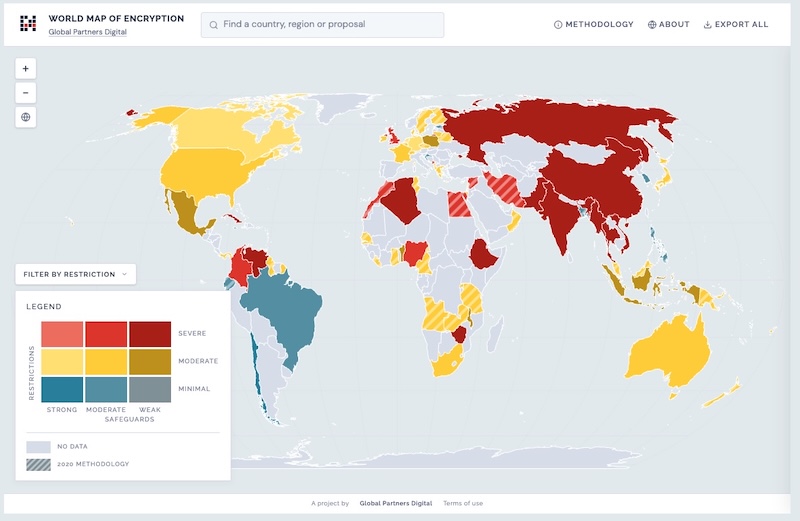
Last month, Global Partners Digital relaunched the World Map of Encryption Laws and Policies. While the World Map has been live since 2020, the new version introduces a revised, comparative assessment framework, a fresh interface, and new research on 40 countries.
Under the new assessment framework, each country is scored on two dimensions: restrictions (how far laws and policies interfere with or enable strong encryption) and safeguards (how well people are protected against abuse of intrusive powers). Together, the two layers of assessment aim to provide a holistic picture of the legal framework in a given country as it impacts the use of encryption. The research questions, indicators and scoring are public for researchers to scrutinize, use and adapt.
The new interface enables easy, side-by-side comparison between countries, while detailed country profiles break down country scores across multiple indicators.
A Fresh Tool for the Field
The updated map aims to provide advocates, activists and technologists with an up-to-date analytical framework which can be used to assess new threats and compare between proposals. The new dimension of the assessment (safeguards) provides a systematic way of analyzing what checks and balances surround potentially intrusive powers. This new, second layer becomes more vital as harmful proposals often travel across borders to countries with even weaker institutional and procedural guardrails.
Whether you are looking for detailed analysis of a country’s regulatory framework, a birdseye view of how different countries rank globally, or a set of research questions to determine whether a new proposal undermines strong encryption, we hope the map can offer a clear and accessible reference point for advocates, technologists and policymakers alike.
Encryption Policy Trends: from Bans to Backdoors and Scans
The map currently covers 100 countries: 40 assessed under the updated methodology and a further 60 reflecting the old one. While not yet comprehensive, new research already tells us a lot about how countries are protecting or undermining encryption as a technology people rely on every day. As it stands today, it documents:
Rising attempts to mandate lawful access by design: both Australia (through the Telecommunications and Other Legislation Act) and the UK (through the Investigatory Powers Act) operate technical notice regimes, enabling the government to compel providers to build and maintain lawful access capabilities into encrypted services. Both regimes are cloaked in secrecy (observable under the research indicator on Transparency). Similar proposals are emerging elsewhere: Canada’s Bill C-22 (Lawful Access Act), Sweden’s Data Storage and Access to Electronic Information Bill (currently delayed following interventions by the Global Encryption Coalition and the Swedish Armed Forces), and Ireland’s Communications (Interception and Lawful Access) Bill all follow similar models. Democracies, not just authoritarian states, are driving many of these proposals. This requires continued monitoring, as copycat proposals and justifications for them travel across borders. This is alarming, but just as we learn from the challenges, we can also learn from the advocacy successes – such as in Sweden, where the proposal has stalled following strong opposition from actors as varied as the Global Encryption Coalition and the Swedish armed forces.
Alongside newer policy developments, blocking, throttling and other forms of direct interference with encryption continues. From Russia to China, Myanmar to Venezuela, country laws authorise sustained network-level blocking of VPN services and encrypted platforms (analysed under research indicators on General prohibition of encryption, and Extra-legal restrictions).
New research also shows how early warning signs are consolidating into deeper trends. For instance, proposals which purport to improve children’s safety but risk entrenching surveillance and increasing exposure to data-related harms. The EU’s proposed CSAR Regulation (known informally as Chat Control) would have mandated client-side scanning of private messages, however the proposal was later removed and the adopted Regulation explicitly exempts end-to-end encryption (E2EE) messaging. The UK’s Online Safety Act (in force since July 2025) similarly provides a legislative basis for mandatory scanning, though it is not yet being enforced. Client side scanning effectively breaks E2EE by scanning messages before they’re encrypted, treating all of our communications as suspect.
Combined with this, the research shows a growing number of countries enacting laws and policies that erode online anonymity: from attempts to introduce age-verification architectures to restrict access to certain platforms and features for children and young adults to traceability mandates or laws linking identities to devices. While these laws and proposals do not directly interfere with encryption, they open the door to vast collection and retention of sensitive user data and linking users’ identities to their online activity, creating a chilling effect and heightening the risk of data exploitation by third parties or commercial actors.
However, new, privacy-preserving frameworks are also emerging, with explicit and indirect protection of encryption.Brazil’s approach under ECA Digital enshrines privacy by default and explicitly refers to encryption as a tool to be adopted to satisfy constitutional guarantees of the privacy of communications. Chile’s Cybersecurity Framework Law states that every person has the right to adopt technical security measures such as encryption. Analysis of laws and policies that create an enabling framework for encryption offers insights for policymakers on the way forward.
For members of the Global Encryption Coalition, advocates and allies, the map also highlights real examples of where threats to encryption were effectively averted or stalled – from Sweden to Nigeria to Pakistan – showing where our advocacy is making a difference.
Coming next: with support from the Internet Society, we will soon publish a trends report covering the 40 newly updated countries.